Ultimate SAW Machine Efficiency Guide for Industrial Welding Productivity in 2026
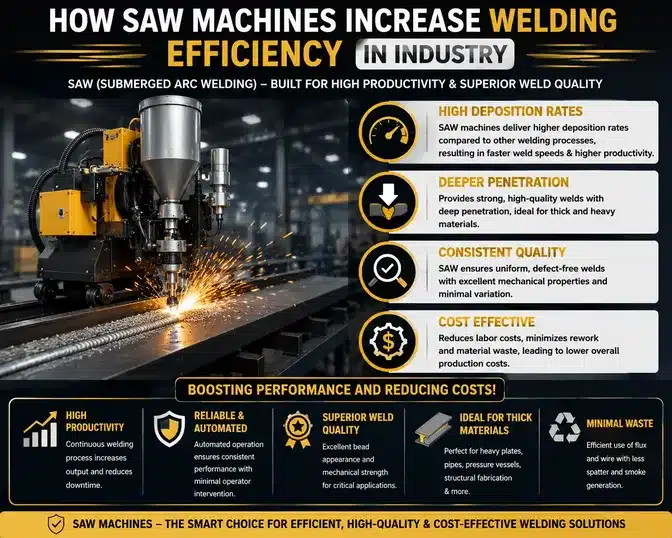
Ultimate SAW Machine Efficiency Guide for Industrial Welding Productivity in 2026
Manufacturing industries worldwide continue facing increasing pressure to improve production efficiency, reduce operating costs, and maintain superior weld quality. As infrastructure, shipbuilding, pressure vessel fabrication, and heavy engineering projects expand globally, welding productivity has become a major competitive advantage.
Among advanced industrial welding technologies, SAW machine efficiency remains one of the most important factors driving manufacturing performance in 2026. Submerged Arc Welding (SAW) systems offer exceptional deposition rates, deep weld penetration, reduced defects, and high automation potential, making them ideal for large-scale fabrication operations.
Whether your operation focuses on structural steel fabrication, offshore construction, wind energy components, pipelines, or heavy equipment manufacturing, investing in high-efficiency SAW machines can significantly improve throughput, quality, and long-term profitability.
Table of Contents
- What is a SAW Machine?
- How Submerged Arc Welding Works
- Why SAW Machine Efficiency Matters
- Top SAW Machine Manufacturers in 2026
- Benefits of High-Efficiency SAW Systems
- SAW vs Other Welding Processes
- Cost and ROI Analysis
- How to Choose the Best SAW Machine
- Future Trends in Welding Automation
- Frequently Asked Questions
What is a SAW Machine?
A Submerged Arc Welding (SAW) machine is an advanced welding system that creates high-quality welds using a continuously fed consumable electrode and a blanket of granular flux. The welding arc remains submerged beneath the flux layer, protecting the weld from atmospheric contamination.
This process is widely used in heavy fabrication industries where high deposition rates, deep penetration, and superior weld consistency are essential.
Industries Using SAW Machines
- Shipbuilding
- Pressure vessel manufacturing
- Pipeline fabrication
- Wind tower production
- Structural steel fabrication
- Heavy equipment manufacturing
- Oil and gas infrastructure
How Submerged Arc Welding Works
The SAW process uses an automatically fed wire electrode while granular flux covers the weld area. The flux melts during welding and forms a protective slag layer that prevents contamination and improves weld quality.
- Wire electrode feeds automatically.
- Electric arc forms beneath flux.
- Flux shields molten metal.
- Deep penetration weld is created.
- Slag cools and protects the weld.
Because the arc is completely submerged, SAW machines produce minimal spatter, low fume generation, and excellent welding efficiency.
Why SAW Machine Efficiency Matters
Modern manufacturers constantly seek ways to maximize production output while maintaining weld quality. High-efficiency SAW machines provide significant operational advantages compared to conventional welding processes.
Higher Deposition Rates
SAW systems can achieve deposition rates several times higher than manual welding processes, dramatically increasing productivity.
Reduced Labor Costs
Automation reduces manual intervention and allows operators to oversee multiple welding stations simultaneously.
Consistent Weld Quality
Automated control systems ensure repeatable weld parameters and minimize human error.
- Reduced weld defects
- Improved penetration
- Higher consistency
- Lower rework rates
Top SAW Machine Manufacturers in 2026
Several leading welding technology companies continue driving innovation in submerged arc welding systems.
| Manufacturer | Country | Specialization |
|---|---|---|
| Lincoln Electric | USA | Industrial Welding Automation |
| Miller Electric | USA | Heavy Fabrication Welding |
| ESAB | Sweden | Advanced SAW Solutions |
| TRUMPF | Germany | Automated Manufacturing Systems |
| Fronius | Austria | Precision Welding Technology |
| Panasonic Welding | Japan | Industrial Automation Welding |
| OTC Daihen | Japan | Robotic Welding Systems |
| EWM | Germany | Energy Efficient Welding Equipment |
Manufacturers in the USA and Germany often prefer Lincoln Electric and TRUMPF for heavy-duty fabrication applications, while companies in France and Italy increasingly choose Fronius and ESAB for precision engineering projects.
Benefits of High-Efficiency SAW Machines
Improved Productivity
Modern SAW systems can significantly increase welding speed while maintaining excellent weld quality standards.
- Higher production throughput
- Faster project completion
- Reduced downtime
- Improved resource utilization
Lower Operational Costs
Improved efficiency leads to lower labor costs, reduced consumable usage, and decreased rework requirements.
Enhanced Weld Quality
Deep penetration and stable arc characteristics contribute to stronger, more reliable welds.
Improved Workplace Safety
Because the welding arc remains submerged beneath flux, operators experience lower exposure to fumes, ultraviolet radiation, and spatter.
SAW vs Other Welding Processes
| Parameter | SAW | MIG | TIG | Stick Welding |
|---|---|---|---|---|
| Productivity | Excellent | High | Moderate | Low |
| Automation Capability | Excellent | Good | Limited | Limited |
| Deposition Rate | Very High | High | Low | Low |
| Weld Quality | Excellent | Good | Excellent | Moderate |
| Best Application | Heavy Fabrication | General Manufacturing | Precision Welding | Field Work |
SAW Machine Cost and ROI Analysis
While industrial-grade SAW systems require substantial initial investment, they often generate significant long-term savings.
| Parameter | Value |
|---|---|
| SAW System Investment | $80,000 - $500,000 |
| Annual Labor Savings | $40,000 |
| Productivity Increase | $60,000 |
| Reduced Rework Costs | $15,000 |
| Total Annual Benefit | $115,000 |
| Estimated Payback Period | 2-4 Years |
How to Choose the Best SAW Machine in 2026
Selecting the right SAW machine requires evaluating production requirements, material specifications, and automation objectives.
- Determine production volume requirements
- Evaluate material thickness range
- Consider automation capabilities
- Assess maintenance requirements
- Review future scalability needs
Facilities with high-volume fabrication operations typically benefit most from fully automated SAW systems integrated with robotic handling and smart monitoring technologies.
Future Trends in Welding Automation
Welding technology continues evolving through Industry 4.0 integration, artificial intelligence, and advanced automation systems.
- AI-driven weld parameter optimization
- Robotic welding integration
- Digital twin technology
- Cloud-based production monitoring
- Predictive maintenance systems
Countries such as Germany, France, and the Netherlands continue investing heavily in automated welding technologies to improve manufacturing competitiveness and productivity.
Frequently Asked Questions
What is a SAW machine and how does it work?
A SAW machine performs submerged arc welding by using a continuously fed wire electrode beneath a protective layer of flux to create high-quality welds.
How much does a SAW machine cost in 2026?
Industrial SAW machines typically range from $80,000 to more than $500,000 depending on automation level and production capacity.
Which SAW machine is best for small versus large manufacturers?
Smaller manufacturers may benefit from semi-automatic systems, while large fabrication facilities often require fully automated SAW solutions.
What industries benefit most from SAW machines?
Shipbuilding, pressure vessel manufacturing, structural steel fabrication, pipeline construction, wind energy, and heavy equipment industries benefit significantly.
How do you choose the right SAW machine?
Consider production volume, material thickness, automation requirements, maintenance costs, and future scalability objectives.
Can SAW machines integrate with existing automation systems?
Yes. Modern SAW systems integrate with PLCs, robotics, MES software, ERP platforms, and Industry 4.0 environments.
What is the ROI of investing in SAW machine technology?
Many manufacturers achieve ROI within two to four years through higher productivity, reduced labor costs, and improved weld quality.
Conclusion
SAW machine efficiency continues to play a critical role in improving industrial welding productivity in 2026. With superior deposition rates, exceptional weld quality, and strong automation capabilities, submerged arc welding remains one of the most effective solutions for heavy fabrication industries.
Leading manufacturers such as Lincoln Electric, Miller Electric, ESAB, TRUMPF, Fronius, Panasonic Welding, OTC Daihen, and EWM continue advancing welding technologies that help companies reduce costs and improve production performance.
As detailed in our guide on Industrial Welding Automation Systems, investing in advanced welding equipment can significantly improve manufacturing efficiency. For additional insights, explore our guides on Conveyor Automation Solutions and Energy Efficient Industrial Equipment to further optimize your operations.
Comments (3)