Ultimate Active vs Passive Harmonic Filters Guide for Industrial Power Quality in 2026
Ultimate Active vs Passive Harmonic Filters Guide for Industrial Power Quality in 2026
Power quality issues cost industrial facilities billions of dollars annually through equipment failures, production downtime, overheating, and energy losses. As manufacturing facilities become increasingly dependent on variable frequency drives (VFDs), automation systems, robotics, and renewable energy installations, harmonic distortion has become a major challenge for modern industrial operations.
Understanding active vs passive harmonic filters is essential for manufacturers seeking reliable electrical performance, improved energy efficiency, and compliance with international power quality standards. In 2026, facilities across the USA, UK, Germany, Netherlands, Italy, and France continue investing in advanced harmonic mitigation technologies to protect critical equipment and maximize operational uptime.
Whether your facility operates CNC machines, industrial robots, conveyor systems, renewable energy infrastructure, or process manufacturing equipment, selecting the right harmonic filter can significantly impact power quality, maintenance costs, and long-term ROI.
Table of Contents
- Understanding Harmonic Distortion
- What Are Active Harmonic Filters?
- What Are Passive Harmonic Filters?
- Active vs Passive Harmonic Filters Comparison
- Leading Harmonic Filter Manufacturers in 2026
- Benefits of Active Harmonic Filters
- Benefits of Passive Harmonic Filters
- How to Choose the Right Harmonic Filter
- Harmonic Filter ROI Analysis
- Future Trends in Power Quality Solutions
- Frequently Asked Questions
Understanding Harmonic Distortion
Harmonics are unwanted electrical frequencies generated by non-linear loads operating within industrial power systems. These distortions negatively impact equipment efficiency, increase energy consumption, and can significantly reduce the lifespan of critical electrical infrastructure.
Common sources of harmonic distortion include variable frequency drives, CNC machinery, industrial robots, UPS systems, solar inverters, battery storage systems, and data center equipment. As Industry 4.0 adoption grows, harmonic management becomes increasingly important.
- Variable Frequency Drives (VFDs)
- CNC Machines
- Industrial Robotics
- UPS Systems
- Solar Inverters
- Battery Energy Storage Systems
What Are Active Harmonic Filters?
Active Harmonic Filters (AHFs) are advanced electronic devices that continuously monitor electrical systems and inject compensating currents to eliminate harmonic distortion in real time. They provide dynamic correction regardless of load variations.
Unlike conventional filtering methods, active filters automatically adapt to changing power conditions, making them highly effective for modern manufacturing environments with fluctuating electrical loads.
How Active Harmonic Filters Work
- Detect harmonic distortion in the power network.
- Analyze waveform characteristics in real time.
- Generate compensating currents.
- Cancel unwanted harmonic frequencies.
- Improve overall power quality.
Key Features
- Dynamic harmonic compensation
- Real-time monitoring
- Automatic adjustment
- High filtering efficiency
- Scalable architecture
- Industry 4.0 compatibility
What Are Passive Harmonic Filters?
Passive Harmonic Filters (PHFs) use combinations of capacitors, inductors, and resistors tuned to specific frequencies to reduce harmonic distortion. They offer a cost-effective solution for facilities with relatively stable load profiles.
These filters are widely used in manufacturing plants, water treatment facilities, pumping stations, and HVAC applications where harmonic characteristics remain relatively predictable.
How Passive Harmonic Filters Work
- Target specific harmonic frequencies
- Divert unwanted harmonics away from equipment
- Improve power factor
- Reduce electrical losses
- Enhance equipment reliability
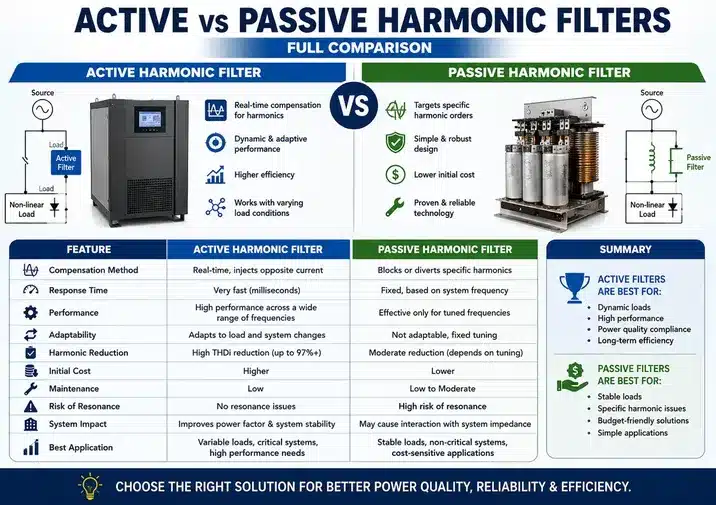
Active vs Passive Harmonic Filters Comparison
| Feature | Active Harmonic Filters | Passive Harmonic Filters |
|---|---|---|
| Harmonic Reduction | Excellent | Good |
| Dynamic Load Response | Excellent | Limited |
| Initial Cost | Higher | Lower |
| Maintenance Requirements | Moderate | Low |
| Scalability | Excellent | Limited |
| Industry 4.0 Integration | Excellent | Limited |
| Best for Automation | Yes | Limited |
Leading Harmonic Filter Manufacturers in 2026
Several global companies continue to drive innovation in industrial power quality and harmonic mitigation technologies.
| Company | Country | Specialization |
|---|---|---|
| Siemens Energy | Germany | Industrial Power Quality Solutions |
| Schneider Electric | France | Active Harmonic Filters |
| ABB | Switzerland | Smart Power Systems |
| GE Renewable Energy | USA | Grid Integration Solutions |
| Voith | Germany | Industrial Energy Infrastructure |
| Alstom | France | Utility Power Applications |
Benefits of Active Harmonic Filters
Active harmonic filters provide superior harmonic mitigation performance and are especially effective in facilities with rapidly changing electrical loads.
- Real-time harmonic correction
- Broad-spectrum filtering capability
- Reduced electrical losses
- Improved equipment reliability
- Enhanced power factor correction
- Smart monitoring capabilities
Facilities operating CNC machines, industrial robots, semiconductor manufacturing equipment, and automated production lines often achieve the greatest benefits from active filtering technologies.
Benefits of Passive Harmonic Filters
Passive harmonic filters remain a popular choice because of their lower upfront costs and straightforward installation process.
- Lower capital investment
- Simplified installation
- Minimal maintenance requirements
- Reliable performance for stable loads
- Improved power factor
Typical passive harmonic filter systems range from $2,000 to $60,000 or more depending on application size and harmonic mitigation requirements.
How to Choose the Right Harmonic Filter
Selecting the best harmonic filter depends on your facility's operating conditions, electrical infrastructure, and future expansion plans.
Evaluate Load Characteristics
- Load variability
- Equipment type
- Harmonic distortion levels
- Expansion requirements
Analyze Budget Requirements
While passive filters typically require lower upfront investment, active filters often provide better long-term value through enhanced performance and flexibility.
Review Compliance Standards
- IEEE 519 compliance
- IEC standards
- Utility requirements
- ESG initiatives
Harmonic Filter ROI Analysis
Investing in harmonic mitigation can generate significant returns through reduced downtime, lower maintenance costs, and improved energy efficiency.
| Parameter | Value |
|---|---|
| Active Filter Investment | $50,000 |
| Annual Energy Savings | $8,000 |
| Maintenance Savings | $6,000 |
| Downtime Reduction Savings | $12,000 |
| Total Annual Benefit | $26,000 |
| Estimated Payback Period | 2-4 Years |
Future Trends in Power Quality Solutions
Future harmonic filtering technologies are increasingly incorporating artificial intelligence, cloud connectivity, predictive maintenance, and smart grid integration capabilities.
- AI-powered power quality management
- Smart grid communication
- Renewable energy integration
- Predictive diagnostics
- Real-time energy optimization
Countries such as Germany, France, and the Netherlands continue investing heavily in smart electrical infrastructure and advanced power quality technologies.
Frequently Asked Questions
What are harmonic filters and how do they work?
Harmonic filters reduce unwanted electrical frequencies generated by non-linear loads, improving power quality and protecting equipment.
How much do harmonic filters cost in 2026?
Passive filters typically range from $2,000 to $60,000+, while active filters can range from $10,000 to more than $150,000.
Which harmonic filter is best for small manufacturers?
Passive filters are often suitable for smaller facilities with stable electrical loads, while active filters are preferred for dynamic manufacturing environments.
What industries benefit most from harmonic filters?
Manufacturing, renewable energy, data centers, automotive production, semiconductor manufacturing, and process industries benefit significantly.
Can harmonic filters integrate with existing systems?
Yes, modern harmonic filters integrate with PLCs, SCADA systems, energy management platforms, and Industry 4.0 infrastructures.
What is the ROI of investing in harmonic filters?
Many facilities achieve ROI within two to four years through energy savings, equipment protection, and reduced downtime.
Conclusion
The decision between active vs passive harmonic filters depends on your facility's operational requirements, power quality challenges, and long-term business goals. Active filters offer superior flexibility and real-time compensation, while passive filters provide cost-effective solutions for stable electrical environments.
Leading companies such as Siemens Energy, Schneider Electric, ABB, GE Renewable Energy, Voith, Alstom, Veolia, and Cummins continue advancing power quality technologies that help manufacturers improve efficiency, reduce downtime, and maximize equipment reliability.
By selecting the right harmonic filtering solution, your facility can achieve improved power quality, better energy efficiency, lower operating costs, and stronger long-term ROI in 2026 and beyond.
Comments (3)