Ultimate Vacuum vs Conventional Furnaces Guide 2026: Best Industrial Heat Treatment Solutions
Ultimate Vacuum vs Conventional Furnaces Guide 2026: Best Industrial Heat Treatment Solutions
Heat treatment remains one of the most critical processes in modern manufacturing. In 2026, manufacturers across the United States, United Kingdom, Germany, Netherlands, Italy, and France are investing heavily in advanced thermal processing technologies to improve quality, efficiency, and sustainability.
One of the most important decisions for industrial facilities is choosing between vacuum furnaces and conventional furnaces. Each technology offers unique advantages depending on production requirements, quality standards, and budget considerations.
This guide explains the differences between vacuum and conventional furnaces, compares performance and costs, and helps manufacturers select the best solution for their operations.
What Are Vacuum Furnaces?
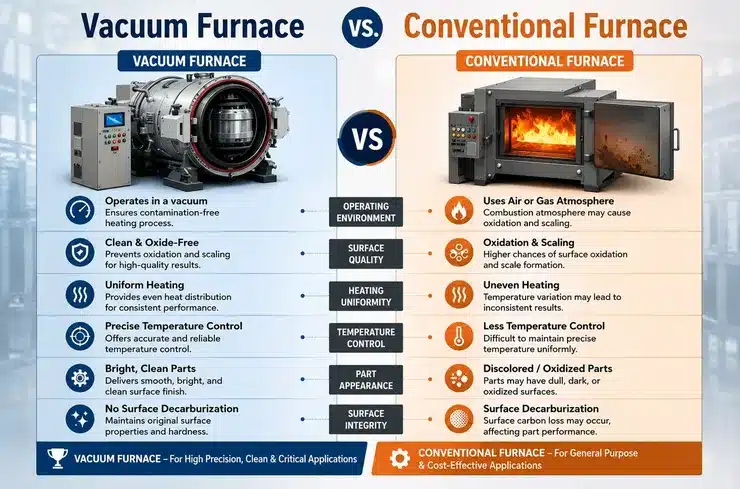
A vacuum furnace is an industrial heat treatment system that removes oxygen, moisture, and contaminants from the heating chamber before processing materials.
The vacuum environment prevents oxidation, scaling, and contamination, producing cleaner and more precise results than traditional heat treatment methods.
How Vacuum Furnaces Work
- Components are loaded into a sealed chamber
- The chamber is evacuated to create a vacuum
- Materials are heated to precise temperatures
- Heat is maintained for the required cycle
- Controlled cooling or gas quenching occurs
- Finished parts are inspected and unloaded
Common Vacuum Furnace Applications
- Aerospace components
- Medical implants
- Tool steels
- Titanium parts
- Automotive gears
- Semiconductor components
- Additive manufacturing parts
What Are Conventional Furnaces?
Conventional furnaces perform heat treatment in atmospheric environments using air, combustion gases, nitrogen, or protective atmospheres.
These systems have been widely used for decades and remain popular for large-scale industrial production.
Types of Conventional Furnaces
- Batch furnaces
- Continuous furnaces
- Belt furnaces
- Pit furnaces
- Box furnaces
- Car-bottom furnaces
- Rotary hearth furnaces
Vacuum vs Conventional Furnaces Comparison
| Feature | Vacuum Furnace | Conventional Furnace |
|---|---|---|
| Oxidation Control | Excellent | Moderate |
| Surface Finish | Superior | Requires Cleaning |
| Temperature Uniformity | Excellent | Good |
| Energy Efficiency | High | Moderate |
| Initial Cost | Higher | Lower |
| Environmental Impact | Lower | Higher |
| ESG Compliance | Strong | Moderate |
Key Benefits of Vacuum Furnaces in 2026
Superior Product Quality
Vacuum heat treatment eliminates oxidation and scaling, resulting in cleaner surfaces and better dimensional accuracy.
- No oxidation
- No scaling
- Better dimensional stability
- Reduced post-processing
- Improved product quality
Enhanced Energy Efficiency
Modern systems from companies such as Siemens, ABB, and Schneider Electric help manufacturers reduce energy consumption and operating costs.
Many facilities achieve energy savings between 15% and 35% compared with older systems.
Better ESG Compliance
Vacuum furnaces help manufacturers meet sustainability objectives by reducing emissions and minimizing waste generation.
- Reduced carbon footprint
- Lower emissions
- Improved sustainability reporting
- Support for ESG initiatives
Precision Temperature Control
Advanced automation systems provide highly accurate temperature management and consistent processing results.
Advantages of Conventional Furnaces
Lower Initial Investment
Conventional furnaces typically require a lower upfront investment than vacuum furnace systems.
Typical pricing ranges from $50,000 to $500,000 depending on size and configuration.
High Production Throughput
Large manufacturing facilities often choose continuous furnaces for high-volume production environments.
Established Technology
Many manufacturers already possess experienced personnel and proven workflows for conventional furnace operations.
Top Industrial Furnace Technology Providers in 2026
- TRUMPF
- Siemens
- ABB
- Schneider Electric
- Bosch Rexroth
- FANUC
- Honeywell
- Emerson Electric
These companies continue to drive innovation in industrial automation, energy efficiency, and smart manufacturing integration.
How to Choose the Right Furnace
Choose Vacuum Furnaces If You Need
- Aerospace certification
- Medical device manufacturing
- Titanium processing
- Premium surface quality
- Improved ESG compliance
Choose Conventional Furnaces If You Need
- High-volume production
- Lower capital expenditure
- General engineering applications
- Large structural components
Vacuum Furnace Cost and ROI in 2026
Vacuum furnace pricing varies depending on capacity and automation features.
- Small systems: $150,000–$400,000
- Mid-size systems: $400,000–$1 million
- Large industrial systems: $1 million–$2.5 million+
Most manufacturers achieve ROI within 2 to 5 years through reduced scrap rates, improved quality, and lower operating costs.
Future Trends in Industrial Furnace Technology
- Artificial intelligence integration
- Industry 4.0 connectivity
- Predictive maintenance
- Digital process monitoring
- Sustainable manufacturing initiatives
- Smart factory integration
Frequently Asked Questions
What is a vacuum furnace and how does it work?
A vacuum furnace removes air and contaminants before heat treatment, preventing oxidation and improving quality.
How much does a vacuum furnace cost in 2026?
Costs typically range from $150,000 to over $2.5 million depending on specifications.
Which furnace is best for small manufacturers?
Conventional furnaces are often preferred for lower upfront costs, while vacuum furnaces offer superior quality and long-term ROI.
What industries benefit most from vacuum furnaces?
Aerospace, medical, automotive, semiconductor, defense, and precision engineering industries benefit significantly.
Can vacuum furnaces integrate with existing systems?
Yes, modern systems integrate with MES, ERP, SCADA, and Industry 4.0 platforms.
What is the ROI of a vacuum furnace?
Most facilities achieve ROI within 2 to 5 years through improved efficiency and product quality.
Final Thoughts
Vacuum vs Conventional Furnaces remains an important decision for manufacturers in 2026. Vacuum furnaces provide superior quality, sustainability, and long-term ROI, while conventional furnaces remain effective for high-volume production environments.
As industrial facilities across the USA, UK, Germany, Netherlands, Italy, and France continue modernizing operations, selecting the right heat treatment technology will play a major role in maintaining competitiveness and profitability.
Comments (3)