Ultimate Laser Sintering vs Traditional Manufacturing Cost Comparison Guide for 2026
Ultimate Laser Sintering vs Traditional Manufacturing Cost Comparison Guide for 2026
Manufacturers across the globe are increasingly evaluating advanced production technologies to remain competitive in an era of digital transformation. One of the most significant decisions facing industrial companies in 2026 is whether to invest in laser sintering systems or continue relying on traditional manufacturing methods.
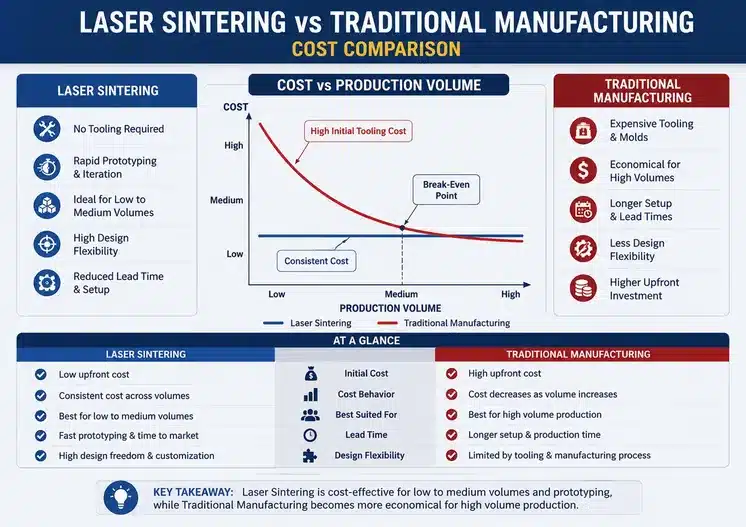
Laser sintering technology, commonly known as Selective Laser Sintering (SLS), has revolutionized industrial production by enabling rapid prototyping, complex geometries, and highly customized parts without expensive tooling requirements. Meanwhile, traditional manufacturing methods such as machining, casting, forging, and injection molding continue to dominate high-volume production environments due to their economies of scale.
This comprehensive guide examines laser sintering vs traditional manufacturing costs, comparing investment requirements, material utilization, production speed, labor expenses, and return on investment to help manufacturers make informed decisions in 2026.
Table of Contents
- Understanding Laser Sintering Technology
- Traditional Manufacturing Overview
- Major Manufacturing Cost Factors
- Tooling Cost Comparison
- Material Usage Analysis
- Production Speed and Lead Times
- Labor Cost Comparison
- Production Volume Economics
- Industrial ROI Analysis
- Future Manufacturing Trends
- Frequently Asked Questions
- Conclusion
Understanding Laser Sintering Technology
Selective Laser Sintering is an advanced additive manufacturing process that builds components layer by layer using powdered materials fused together by a high-powered laser. Unlike conventional manufacturing methods, SLS does not require molds, dies, or specialized tooling.
The technology is widely used across aerospace, automotive, medical, defense, and industrial engineering sectors where precision, customization, and rapid product development are critical.
Key Advantages of Laser Sintering
- No tooling requirements
- Complex geometry production
- Rapid design iterations
- Minimal material waste
- Highly customized manufacturing
- Reduced inventory requirements
Traditional Manufacturing Overview
Traditional manufacturing encompasses processes such as CNC machining, injection molding, die casting, forging, stamping, and conventional fabrication methods.
These technologies remain the preferred solution for large-scale production due to lower per-unit costs at higher production volumes.
Common Traditional Manufacturing Processes
- CNC machining
- Injection molding
- Metal casting
- Forging operations
- Sheet metal fabrication
- Industrial stamping
Conclusion
The debate between laser sintering and traditional manufacturing is not about replacing one technology with another. Instead, successful manufacturers in 2026 are increasingly combining both approaches to maximize flexibility, efficiency, and profitability.
By understanding the strengths, limitations, and cost implications of each manufacturing method, organizations can build production strategies that deliver sustainable growth, improved competitiveness, and stronger long-term returns.
Comments (3)