Ultimate Hydro Turbine Types Comparison Guide 2026
Ultimate Hydro Turbine Types Comparison Guide 2026
Hydropower continues to be one of the most efficient renewable energy sources in 2026. Across the United States, United Kingdom, Germany, Netherlands, Italy, and France, governments and industrial organizations are investing heavily in hydroelectric infrastructure to achieve sustainability goals and improve energy security.
Selecting the right hydro turbine is critical for maximizing efficiency, reducing maintenance costs, and ensuring long-term return on investment. Different turbine designs are engineered for specific water flow rates and head conditions, making turbine selection one of the most important decisions in any hydropower project.
Table of Contents
- What Is a Hydro Turbine?
- Major Types of Hydro Turbines
- Hydro Turbine Comparison Table
- Top Hydro Turbine Manufacturers in 2026
- How to Choose the Right Hydro Turbine
- Cost and ROI Analysis
- Future Trends in Hydropower Technology
- Frequently Asked Questions
What Is a Hydro Turbine?
A hydro turbine is a machine that converts the energy of flowing or falling water into mechanical rotation. This rotational energy drives a generator that produces electricity for industrial facilities, utility grids, and renewable energy projects.
Modern hydro turbines can achieve efficiency levels exceeding 90%, making them among the most effective power generation technologies available today.
How Hydro Turbines Work
- Water flows through a penstock or channel
- Water strikes the turbine runner or blades
- The turbine shaft rotates
- A generator converts mechanical energy into electricity
- Power is transmitted to the grid or facility
Major Types of Hydro Turbines
Pelton Turbine
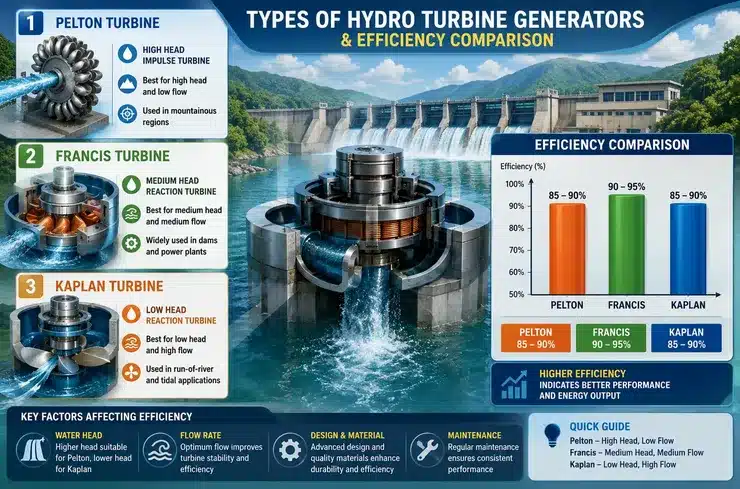
The Pelton turbine is an impulse turbine designed for high-head and low-flow applications. It is commonly used in mountainous regions where water falls from significant elevations.
- Excellent for high-head conditions
- High operational efficiency
- Simple maintenance requirements
- Ideal for remote hydro installations
Francis Turbine
The Francis turbine is the most widely used hydro turbine in large power generation facilities. It operates efficiently across a wide range of flow conditions.
- Suitable for medium-head projects
- High efficiency levels
- Reliable long-term operation
- Common in utility-scale hydro plants
Kaplan Turbine
Kaplan turbines are reaction turbines optimized for low-head and high-flow environments.
- Adjustable blades
- Excellent low-head performance
- High efficiency during flow changes
- Popular in river-based power stations
Propeller Turbine
Propeller turbines feature fixed blades and are often selected for smaller industrial hydropower projects.
- Lower installation cost
- Simple design
- Reduced maintenance complexity
- Suitable for consistent flow conditions
Crossflow Turbine
Crossflow turbines are commonly used in small hydropower systems and rural electrification projects.
- Affordable investment
- Easy maintenance
- Good efficiency for small projects
- Reliable operation
Hydro Turbine Comparison Table
| Turbine Type | Head Range | Flow Rate | Efficiency | Best Application | Typical Cost 2026 |
|---|---|---|---|---|---|
| Pelton | High | Low | 85% - 92% | Mountain Hydropower | $500,000 - $15M |
| Francis | Medium | Medium | 90% - 95% | Utility Power Plants | $1M - $50M+ |
| Kaplan | Low | High | 88% - 94% | River Hydropower | $800,000 - $30M |
| Propeller | Low | High | 80% - 88% | Industrial Facilities | $300,000 - $10M |
| Crossflow | Low-Medium | Low-Medium | 75% - 88% | Small Hydro Systems | $50,000 - $2M |
Top Hydro Turbine Manufacturers in 2026
- Siemens Energy
- Voith
- GE Renewable Energy
- EDF
- ABB
- Schneider Electric
- Alstom
- Veolia
Manufacturers in the USA and Germany often prefer Siemens Energy and Voith for large-scale hydropower projects, while organizations in France and Italy increasingly deploy Schneider Electric and ABB solutions for digital energy management.
How to Choose the Right Hydro Turbine
1. Evaluate Hydraulic Head
High-head sites generally favor Pelton turbines, while low-head locations often require Kaplan turbines.
2. Measure Water Flow
Accurate flow data is essential for selecting the correct turbine size and maximizing efficiency.
3. Assess Project Scale
Small facilities often choose Crossflow turbines, while utility-scale projects typically invest in Francis or Kaplan systems.
4. Consider Automation Requirements
- SCADA integration
- Predictive maintenance
- Remote monitoring
- Digital twin technology
5. Analyze Long-Term ROI
Evaluate maintenance costs, energy output, equipment lifespan, and operational reliability before making a final decision.
Hydro Turbine Cost and ROI Analysis
Hydro turbine pricing depends on project size, engineering complexity, site conditions, and automation requirements.
- Small Hydro Projects: $50,000 to $2 Million
- Medium Hydro Projects: $2 Million to $20 Million
- Large Utility Projects: $20 Million to $500 Million+
Most hydropower projects achieve a return on investment within 5 to 15 years through reduced operating costs and renewable energy generation.
Future Trends in Hydropower Technology
- AI-powered turbine optimization
- Predictive maintenance systems
- Smart grid integration
- Digital twin technology
- Remote asset monitoring
- Advanced blade materials
- ESG performance reporting
Hydropower operators across Europe and North America continue investing in digital technologies to improve efficiency, reliability, and sustainability.
Frequently Asked Questions
What is a hydro turbine and how does it work?
A hydro turbine converts water energy into mechanical energy, which is then transformed into electricity by a generator.
How much does a hydro turbine cost in 2026?
Costs range from approximately $50,000 for small systems to over $500 million for large utility-scale installations.
Which hydro turbine is best for small manufacturers?
Crossflow and Propeller turbines are often the most cost-effective choices for smaller facilities.
What industries benefit most from hydro turbines?
Utilities, manufacturing, mining, municipal infrastructure, and renewable energy developers benefit significantly from hydropower systems.
Can hydro turbines integrate with existing systems?
Yes. Modern turbines can integrate with SCADA systems, industrial automation platforms, and smart grid technologies.
What is the ROI of hydro turbine investments?
Most projects recover investment costs within 5 to 15 years while providing decades of renewable energy production.
Final Thoughts
Hydro turbines remain a cornerstone of renewable energy generation in 2026. Understanding the differences between Pelton, Francis, Kaplan, Propeller, and Crossflow turbines allows organizations to maximize efficiency and long-term profitability.
With continued innovation from Siemens Energy, Voith, ABB, Schneider Electric, GE Renewable Energy, EDF, Alstom, and Veolia, hydropower technology will continue to play a vital role in the global transition toward sustainable energy.
Comments (3)