Best Coordinate Measuring Machines for Industrial Quality Control in 2026
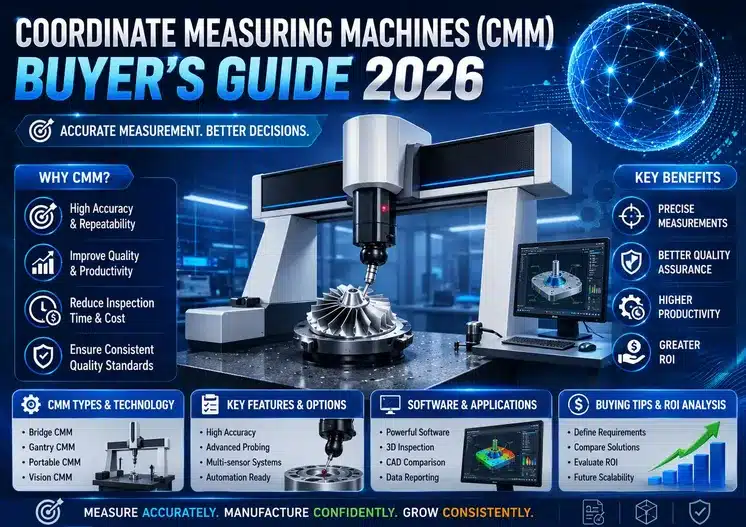
Best Coordinate Measuring Machines for Industrial Quality Control in 2026
In today's precision driven manufacturing environment, dimensional accuracy directly impacts product quality, customer satisfaction, and regulatory compliance. Industries such as aerospace, automotive, medical devices, and electronics increasingly depend on advanced inspection technologies to maintain tight tolerances and eliminate costly defects.
Coordinate Measuring Machines (CMM) have become one of the most important tools in modern quality control. These advanced metrology systems provide highly accurate dimensional measurements, helping manufacturers improve consistency, reduce scrap, and optimize production processes.
What is a Coordinate Measuring Machine (CMM)?
A Coordinate Measuring Machine (CMM) is a precision inspection system used to measure the physical geometrical characteristics of a component. Using probes, laser scanners, or optical sensors, a CMM captures dimensional data and compares it against engineering specifications or CAD models.
These machines are widely used in quality control, reverse engineering, process validation, and production inspection across numerous industries.
Why CMM Machines Are Essential in Modern Manufacturing
Manufacturers rely on advanced inspection systems to ensure consistency, accuracy, and compliance with industry standards.
- Maintain tight dimensional tolerances
- Reduce production errors
- Improve product quality
- Enhance customer satisfaction
- Support regulatory compliance
Types of Coordinate Measuring Machines
1. Bridge CMM
The most common type of CMM used in manufacturing. Bridge CMMs provide excellent stability and high measurement accuracy for medium to large components.
2. Cantilever CMM
Ideal for small and lightweight components, offering easy access during loading and unloading operations.
3. Gantry CMM
Designed for large and heavy components such as aerospace structures, industrial machinery, and automotive frames.
4. Horizontal Arm CMM
Commonly used for large sheet metal parts and automotive body inspections.
5. Portable CMM (Articulated Arm)
Portable systems provide flexibility for on site inspections and large assembly measurements.
Key Features to Consider Before Buying a CMM
Measurement Accuracy
Accuracy is often the most important factor when selecting a CMM. High end systems can achieve micron level precision for demanding applications.
Measurement Volume
Choose a machine capable of measuring your largest components while maintaining required accuracy levels.
Probe Technology
Available options include touch trigger probes, scanning probes, laser scanners, and optical sensors.
Automation Capabilities
Automated CMM systems improve throughput, consistency, and overall inspection efficiency.
Software Integration
Advanced software enables CAD comparison, statistical process control, automated reporting, and production analytics.
CMM Machine Price in 2026
| Type | Price Range (USD) | Best For |
|---|---|---|
| Portable CMM | $10,000 to $50,000 | On Site Inspections |
| Bridge CMM | $50,000 to $200,000 | General Manufacturing |
| Gantry CMM | $200,000 to $1,000,000+ | Large Components |
| Automated CMM Systems | $150,000 to $500,000+ | High Volume Production |
Leading CMM Manufacturers in 2026
- Carl Zeiss
- Hexagon
- Renishaw
- Mitutoyo
- Nikon Metrology
- Keyence
- Wenzel
Manufacturers in the USA and Germany often prefer Carl Zeiss and Hexagon for high precision aerospace and automotive applications, while companies in France and Italy increasingly choose Renishaw and Mitutoyo solutions for precision engineering projects.
Applications of CMM Machines
Automotive Industry
Used for inspecting engines, transmissions, chassis components, and vehicle body structures.
Aerospace Industry
Ensures dimensional accuracy for turbine blades, structural assemblies, and flight critical components.
Medical Devices
Verifies precision requirements for implants, surgical instruments, and medical assemblies.
Electronics Manufacturing
Supports inspection of connectors, housings, and miniature electronic components.
Benefits of Using CMM Machines
1. High Precision Measurement
Provides highly accurate dimensional inspection for complex geometries.
2. Reduced Defects
Identifies manufacturing deviations before products reach customers.
3. Improved Productivity
Automated measurement processes reduce inspection times and increase throughput.
4. Data Driven Decisions
Detailed measurement reports help optimize production processes.
5. Compliance with Standards
Supports ISO, aerospace, automotive, and medical quality requirements.
Manual vs Automated CMM Comparison
| Parameter | Manual CMM | Automated CMM |
|---|---|---|
| Speed | Low | High |
| Accuracy | Moderate | Very High |
| Labor Requirement | High | Low |
| Cost | Lower | Higher |
ROI of CMM Machines
Investing in advanced industrial metrology equipment delivers measurable returns through quality improvements and reduced production costs.
| Metric | Before | After |
|---|---|---|
| Defect Rate | 10% | 2% |
| Inspection Time | High | Reduced |
| Operational Cost | High | Optimized |
Integration with Industry 4.0
Modern CMM machines integrate with smart manufacturing technologies:
- IoT enabled sensors
- Cloud based data storage
- AI driven analytics
- Automated reporting systems
- Digital twin platforms
Future Trends in CMM Technology
- AI powered inspection systems
- Portable wireless CMM devices
- Digital twin integration
- Advanced 3D scanning capabilities
- Fully automated metrology cells
How to Choose the Right CMM Machine
- Define measurement requirements.
- Evaluate accuracy and speed needs.
- Consider automation requirements.
- Analyze total cost of ownership.
- Select a scalable solution.
Expert Tips
- Invest in scalable systems.
- Choose reputable suppliers.
- Focus on long term ROI.
- Ensure Industry 4.0 compatibility.
Conclusion
Coordinate Measuring Machines are essential tools for achieving precision, quality, and efficiency in modern manufacturing. By investing in the right measurement systems, businesses can significantly improve product quality, reduce defects, and enhance operational performance.
Whether you are upgrading an existing quality control process or building a new facility, selecting the right CMM machine is a strategic investment that delivers long term value and competitive advantage.
Ready to enhance your quality control capabilities? Choosing the right Coordinate Measuring Machine can transform your manufacturing operation and support sustainable growth in 2026 and beyond.
Comments (3)