Best Ampoule Filling Machines for Pharmaceutical Manufacturing in 2026
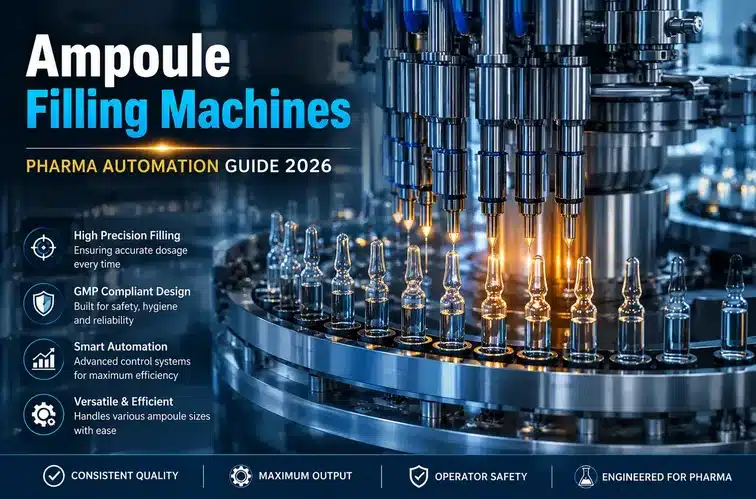
Best Ampoule Filling Machines for Pharmaceutical Manufacturing in 2026
Discover the best ampoule filling machines in 2026. Compare costs, automation features, production capacity, and ROI for pharmaceutical manufacturing.
Introduction
The pharmaceutical industry continues to experience rapid growth, with injectable medications, vaccines, biologics, and sterile products driving increased demand for high-precision packaging equipment. In 2026, manufacturers face stricter regulatory requirements, higher production volumes, and greater expectations for product quality and traceability.
Ampoule filling machines have become essential for pharmaceutical companies seeking accurate liquid dosing, contamination prevention, and efficient production workflows. Modern systems combine automated filling, sealing, inspection, and quality control capabilities to ensure compliance with international GMP standards.
Whether you operate a small pharmaceutical facility or a large-scale manufacturing plant, selecting the right ampoule filling machine can significantly improve productivity, reduce waste, and enhance product consistency.
Table of Contents
- What Are Ampoule Filling Machines
- How Ampoule Filling Machines Work
- Benefits of Automated Ampoule Filling
- Top Manufacturers in 2026
- Comparison Table
- Machine Cost Analysis
- How to Choose the Right System
- Industry Applications
- Frequently Asked Questions
- Conclusion
What Are Ampoule Filling Machines?
Ampoule filling machines are specialized pharmaceutical packaging systems designed to fill sterile liquids into glass ampoules before sealing them under controlled conditions. These machines are widely used in pharmaceutical, biotechnology, healthcare, and laboratory manufacturing environments.
Modern ampoule filling systems integrate advanced dosing technologies, cleanroom compatibility, automated inspection systems, and digital monitoring capabilities to ensure high accuracy and compliance.
Core Components
- Ampoule feeding system
- Liquid dosing station
- Nitrogen flushing system
- Flame sealing station
- Vision inspection system
- Quality control sensors
- Automation control software
How Ampoule Filling Machines Work
Modern ampoule filling operations follow a highly controlled process to ensure sterility and accuracy.
- Ampoules are automatically loaded into the production line
- Containers are cleaned and sterilized
- Liquid product is accurately dosed into each ampoule
- Nitrogen flushing removes oxygen when required
- Ampoules are flame sealed
- Automated inspection systems verify quality
- Approved products move to packaging operations
Why Ampoule Filling Machines Are Essential in 2026
The demand for sterile injectable products continues to increase globally. Pharmaceutical manufacturers require reliable filling equipment capable of maintaining product integrity while achieving high production efficiency.
Companies operating in the USA, UK, Germany, France, Italy, and the Netherlands increasingly invest in automated pharmaceutical packaging technologies to meet regulatory requirements and improve manufacturing performance.
Key Advantages
- Improved filling accuracy
- Reduced contamination risks
- Higher production output
- Enhanced GMP compliance
- Lower labor costs
- Improved product traceability
Leading Ampoule Filling Machine Manufacturers in 2026
Several manufacturers continue to dominate the pharmaceutical packaging sector with advanced filling technologies.
| Manufacturer | Country | Specialization | Automation Level | Best Application |
|---|---|---|---|---|
| Syntegon | Germany | Pharmaceutical Packaging | High | Large Production Facilities |
| IMA Group | Italy | Aseptic Filling Systems | Very High | Injectable Pharmaceuticals |
| Bausch+Ströbel | Germany | Sterile Packaging Equipment | High | Biopharmaceutical Production |
| Marchesini Group | Italy | Packaging Automation | High | Medium and Large Facilities |
| Watson-Marlow | UK | Precision Filling Technology | High | Sensitive Liquid Products |
Top 5 Features to Look for in Ampoule Filling Machines
- High filling accuracy
- Automated inspection systems
- Cleanroom compatibility
- Integrated data tracking
- Flexible production capacity
Ampoule Filling Machine Cost Comparison
Pricing varies significantly depending on automation level, production speed, and regulatory requirements.
- Entry-level systems: $50,000 to $150,000
- Semi-automatic machines: $150,000 to $500,000
- Fully automatic lines: $500,000 to $3 million
- Custom aseptic systems: $3 million to $10 million+
Manufacturers in the UK typically budget between £40,000 and £8 million depending on production requirements.
How to Choose the Right Ampoule Filling Machine
Production Volume Requirements
Determine expected output levels before selecting machine capacity.
Regulatory Compliance
Ensure equipment meets GMP, FDA, EMA, and other relevant standards.
Automation Needs
Evaluate whether manual, semi-automatic, or fully automated systems best suit your facility.
Future Expansion
Select equipment capable of supporting future production growth.
Industry Applications
Pharmaceutical Manufacturing
Production of injectable drugs, vaccines, antibiotics, and sterile solutions.
Biotechnology
Packaging of biologics, cell therapies, and specialized treatments.
Healthcare Products
Manufacturing of diagnostic solutions and medical formulations.
Research Laboratories
Small-batch production and clinical trial applications.
Regional Adoption Trends
Manufacturers in Germany often prefer advanced systems from Syntegon and Bausch+Ströbel for high-volume sterile production. Pharmaceutical companies in Italy increasingly deploy IMA Group and Marchesini technologies for flexible manufacturing operations.
In France and the Netherlands, growing investments in biotechnology continue driving demand for automated aseptic filling solutions. Meanwhile, pharmaceutical manufacturers in the USA and UK prioritize digital integration, data tracking, and regulatory compliance capabilities.
Frequently Asked Questions
What is an ampoule filling machine?
An ampoule filling machine is a pharmaceutical packaging system used to accurately fill and seal sterile liquids inside glass ampoules.
How much does an ampoule filling machine cost in 2026?
Prices typically range from $50,000 for basic systems to more than $10 million for advanced aseptic production lines.
Which ampoule filling machine is best for small pharmaceutical manufacturers?
Semi-automatic systems with scalable production capabilities are often ideal for smaller operations.
What industries use ampoule filling machines?
Pharmaceutical, biotechnology, healthcare, diagnostics, and laboratory industries commonly use these systems.
Can ampoule filling machines integrate with existing manufacturing systems?
Yes. Modern equipment supports MES, ERP, SCADA, and Industry 4.0 integration.
What is the ROI of investing in ampoule filling machines?
Manufacturers often achieve ROI through increased productivity, reduced product waste, improved compliance, and lower labor requirements.
Conclusion
The best ampoule filling machines in 2026 combine precision dosing, advanced automation, and strict compliance capabilities to support modern pharmaceutical manufacturing. Investing in the right equipment helps improve production efficiency, maintain product quality, and meet growing global demand.
For additional insights, explore our guides on Pharmaceutical Conveyor Systems, Industrial Automation Solutions, and Quality Control Technologies. Selecting the right ampoule filling machine today can create significant long-term advantages for your manufacturing operation.
Comments (3)